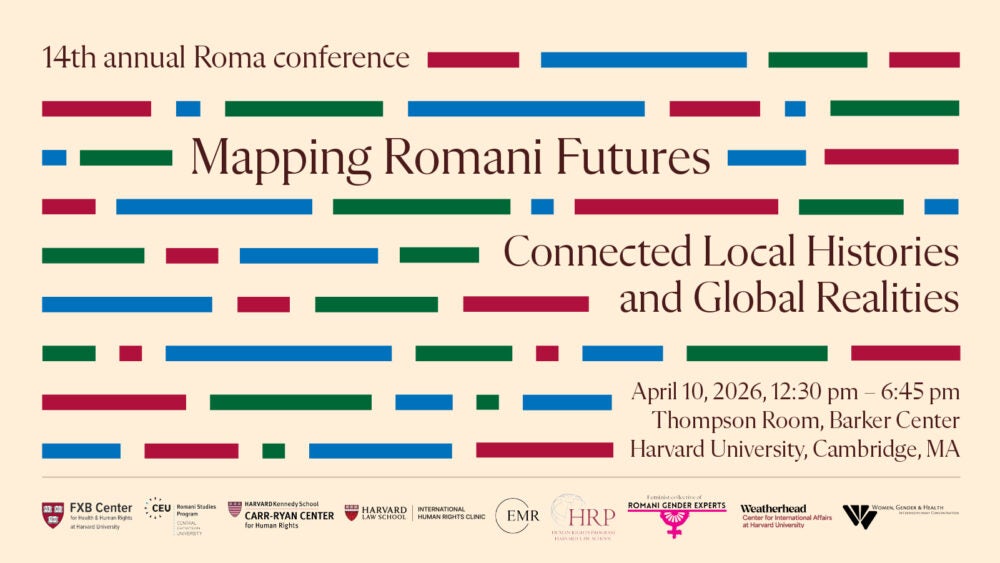
Mapping Romani futures: Connected local histories and global realities 
Date and Time

April 10, 2026
12:30 pm - 6:45 pm

Location

Thompson Room, Barker Center, Harvard University & Zoom

Date and Time: Friday, April 10, 2026 at 12:30pm – 6:45pm EDT. Reception to follow at 7:00pm EDT.

Location: 110 Thompson Room, Barker Center, 12 Quincy St, Cambridge MA 02138 (Harvard University) and online on Zoom

In partnership with the Harvard University Committee on Ethnicity, Migration, Rights (EMR), and the Weatherhead Center for International Affairs at Harvard University, the Roma Program for Health and Human Rights at the FXB Center for Health and Human Rights will host a free, hybrid-format conference at Harvard University’s Barker Center (110 Thompson Room) on Friday, April 10, 2026. The Barker Center is located at 12 Quincy Street, Cambridge, MA, 02138. It is accessible by public transportation and near several garages but there is no parking on site. A reception will follow.

Background information about International Roma Day (April 8):

Romani people worldwide have celebrated International Roma Day on April 8 for decades. This year marks the 55th anniversary of the First World Roma Congress, a historic milestone when Roma Day, the flag, and the Gelem, Gelem anthem were adopted as symbolic markers of the global Roma diaspora.  

Some neighborhoods, organizations, and institutions have used the anniversary to showcase their heritage via concerts, exhibitions, film screenings, conferences, and media events. Others, including leaders and academics, have observed Roma Day with remembrance events to reflect on anti-Roma racism and progress across social, political, cultural, and economic sectors.  

Conference overview:

Since 2013, the annual Roma conference at Harvard has served as a forum to examine and address anti-Roma racism, including its origins, history, major underpinnings and protectors, and manifestations worldwide, especially as it relates to children and youth. We have aimed to improve data collection related to Roma, particularly youth and children, enhance research methods, focus on participatory action research with Roma youth, and revisit and inform the histories, policies, and practices concerning Romani people. Additionally, the Harvard Roma conference has actively sought to amplify and center the voices and experiences of Romani individuals and young people within global scholarship.  

On April 10, 2026, we will once again observe Roma Day with the 14th Harvard Roma conference, Mapping Romani futures: Connected local histories and global realities.

This year’s event examines Romani histories and realities with the aim of informing more equitable futures for Romani children, youth, and future generations. We will situate these within a global context marked by increasing human rights abuses, wars, extremism, climate and digital threats.  

The conference features a keynote panel on global and regional trends and threats affecting children and youth and their futures, especially amid escalating human rights abuses, wars, extremism, climate and digital threats. 

This will be succeeded by two subsequent panels. The first panel, Connected futures, histories, and realities, will explore connections and continuities in Romani histories and realities, examining how these shape lives, inequities, and identities of Romani children, youth, and future generations. The second panel, Intersectionality and intersecting stories, will unpack typically overlooked and peripheral axes of inequity in the narratives of Romani histories, realities, and futures. Finally, following a tradition established in recent years, the conference will include a book talk featuring recent monographs about Romani people, with particular attention to works that advance global scholarship.

Agenda

12:00pm – 12:30pm: Gathering

12:30pm: Greeting from the Master of Ceremonies

Rayna Emilova, MEd

Rayna Emilova is a Roma educator, researcher, and Fulbright Scholar from Bulgaria
whose work sits at the intersection of educational equity, anti-racism, and social transformation.

Rayna has several years of experience in education and continues to engage with teaching and research as interconnected forms of advocacy. Her work is rooted in the lived realities of
Roma communities in Europe and shaped by a deep commitment to challenging anti-Roma racism, structural exclusion, and the normalization of inequality across institutions. A central thread in her scholarship and practice is the question of belonging, particularly how Roma
students, and Roma women in particular, navigate educational spaces where they are often
positioned as outsiders. She is especially interested in how belonging is shaped (or denied) in white-dominant classrooms across Europe, and what it means to move beyond “inclusion” toward environments where Roma students are genuinely protected, respected, and able to thrive without self-erasure.
Rayna Emilova

12:30pm: Welcoming remarks

Dean for Academic Affairs, Harvard T.H. Chan School of Public Health

Jorge E. Chavarro, MD, DSc

Jorge E. Chavarro is the dean for academic affairs at Harvard T.H. Chan School of Public Health. He is also professor of nutrition and epidemiology at the School, and professor of medicine at Brigham and Women’s Hospital and Harvard Medical School.

Dr. Chavarro’s research focuses on understanding how nutritional, lifestyle and metabolic factors impact human reproduction and reproductive milestones throughout the life course, and how these events impact other aspects of health.
Jorge E. Chavarro, Dean for Academic Affairs, Harvard T.H. Chan School of Public Health

12:40pm: Framing the conference topics

Director of the FXB Center Roma Program for Health and Human Rights

Margareta Matache, PhD

Dr. Margareta (Magda) Matache is a Lecturer on Social and Behavioral Sciences at the Department of Social and Behavioral Sciences, Harvard T.H. Chan School of Public Health, and the co-founder and Director of the Roma Program at the FXB Center for Health and Human Rights, Harvard University. She is also a member of the O’Neill-Lancet Commission on Racism, Structural Discrimination and Global Health.

Dr. Matache’s research focuses on the manifestations and impacts of racism and other systems of oppression in different geographical and political contexts. Her research examines discrimination, reparations, social determinants of health—including education and social and economic disparities—and their nexus with the historical past and contemporary public policies, with a particular focus on anti-Roma racism.
Margareta Matache

12:45pm: Keynote speech – Growing up in an age of crises: Global trends shaping the future of children, youth, and next generations

FXB Director of Research | Chair

Jacqueline Bhabha, JD, MSc

Jacqueline Bhabha is a Professor of the Practice of Health and Human Rights at the Harvard T.H.Chan School of Public Health, the Jeremiah Smith Jr. Lecturer in Law at Harvard Law School, and an Adjunct Lecturer in Public Policy at the Harvard Kennedy School. She is also the Director of Research at the FXB Center for Health and Human Rights at Harvard University.
Jacqueline Bhabha

2:00pm: Panel 1 – Connected futures, histories, and realities

FXB Center Executive Director | Panel Chair and Discussant

Jehane Sedky

Jehane Sedky is a seasoned senior executive with an excellent record in leadership roles, providing strategic guidance and support to influential leaders such as former US President Bill Clinton, former UNICEF Executive Director Carol Bellamy and the late Harvard University Professor Dr. Paul Farmer. Her expertise spans a wide spectrum of responsibilities, including leading major initiatives, strategic program development for social impact, fundraising, media, and communications.
Jehane Sedky
Panelist

Judit Ignacz

Judit Ignacz is a human rights advocate and educator whose work brings together policy
analysis, qualitative research, human rights education, and advocacy at national and
international levels. She regularly presents, writes, and delivers interactive trainings on
psychological safety, strategic equality, and intersectional justice.

As a co-founder of a Roma collective of knowledge producers and co-author of their book on Roma representation and inclusion, Judit is dedicated to challenging harmful narratives and encouraging individuals and organizations to move beyond passive support toward conscious, informed, and proactive actions. Her work confronts systemic racism and advocates for equitable opportunities, representation, and decision-making, particularly for Romani women,
whose lived experiences and needs are still too often overlooked, even within mainstream antiracist and feminist spaces.
Judit Ignacz

3:45pm – 4:00pm: Break

4:00pm: Panel 2 – Fire-side chat: Intersectionality and intersecting stories

Panelist

Alba Hernández Sánchez

Alba Hernández is a feminist and antiracist Romani gender studies expert. Her work centers on Roma women’s rights, Romani feminist knowledge production, and anti-racist activism. She co-founded the Romnja Feminist Library and the Feminist Collective of Romani Gender Experts. These two initiatives join forces by connecting
knowledge production with advocacy, ensuring that Romani feminist voices shape
both political narratives and institutional change. Her activism bridges research,
community-driven action, and racial and gender justice.
Alba Hernandez

6:00pm: Book talk

Panel Chair

Maria Dumitru, MA

Maria Dumitru is a Roma academic and feminist. Currently, she is a PhD candidate at MF Norwegian School of Theology, Religion and Society in Oslo, Norway researching Roma slavery from a gender perspective. She holds an MA in Gender Studies from the Central European University.

Dumitru has worked for the World Bank in Romania, the Roma feminist theatre Giuvlipen and organisations in Oslo working with undocumented migrants who performed informal work. Area of interest: enslavement, homelessness, intersectional feminism, gender studies, and Romani studies.
Director of the FXB Center Roma Program for Health and Human Rights I Panelist

Margareta Matache, PhD

Dr. Margareta (Magda) Matache is a Lecturer on Social and Behavioral Sciences at the Department of Social and Behavioral Sciences, Harvard T.H. Chan School of Public Health, and the co-founder and Director of the Roma Program at the FXB Center for Health and Human Rights, Harvard University. She is also a member of the O’Neill-Lancet Commission on Racism, Structural Discrimination and Global Health.

Dr. Matache’s research focuses on the manifestations and impacts of racism and other systems of oppression in different geographical and political contexts. Her research examines discrimination, reparations, social determinants of health—including education and social and economic disparities—and their nexus with the historical past and contemporary public policies, with a particular focus on anti-Roma racism.
Margareta Matache

7:00pm: Reception

Please direct any questions about this event to Claire Street at cstreet@hsph.harvard.edu.

Speakers’ remarks are based on their own scholarship and experience. As such, they speak for themselves, not for Harvard University.