

Bridging the Atlantic: Legacy, solidarity, and reparations
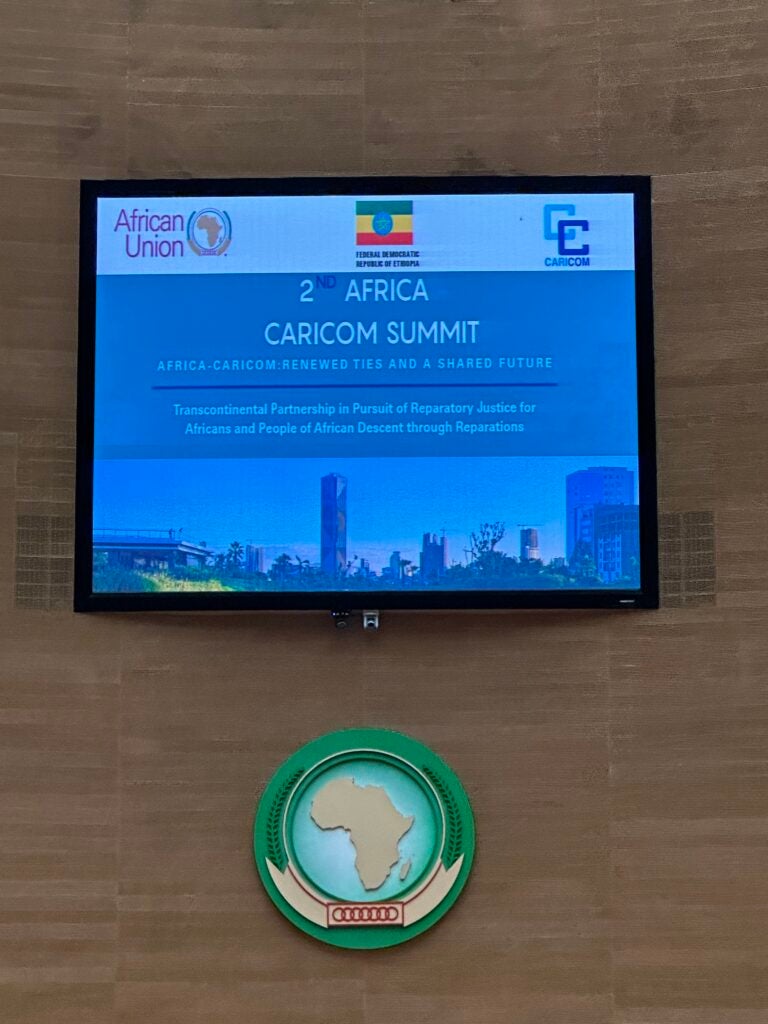
In September 2025 FXB Director, Dr. Mary T. Bassett, MD, MPH, and FXB Research Scientist Brittney Francis, PhD, MPH, attended the 2nd Africa-CARICOM Summit in Addis Ababa. The summit brought together member states from the African Union and CARICOM, along with UN entities and international NGOs, including the global African diaspora. The goal was to strengthen unity, deepen integration, and jointly pursue reparations and reparatory justice through a comprehensive transcontinental partnership framework, under the theme: “Transcontinental Partnership in Pursuit of Reparatory Justice for Africans and People of African Descent through Reparations.”
By Mary T. Bassett, MD, MPH, and Brittney Francis, PhD, MPH
On September 7, 2025, the Second Africa-CARICOM International Summit on Reparations was held in Addis Ababa. Through efforts of the Ethiopian Ministry of Foreign Affairs and colleagues at UC Berkeley, we (Drs. Mary Bassett and Brittney Francis) were credentialed as “special guests,” joining several others from the African diaspora who attended the meeting. This is a brief reflection on that experience.
The Addis meeting took place in the context of the Africa Union’s call for 2025 as “the Year for Reparations: Justice for Africans and People of African Descent.” For those of us in the United States, it was noteworthy that the meeting took place and that it ended with a commitment to another Summit in 2028. Much has changed regarding the possibility of reparations for African enslavement from the U.S. government compared to just five years ago, when during a 2020 debate for the Democratic Party presidential candidate, contenders fielded questions about their support and feasibility of this effort.

In 2025, reparations seem unlikely and infeasible. President Trump has mused about excessive attention to “how bad Slavery was”, ordering the effective removal of attention to the transatlantic slave trade from national museums, public school curriculums, and national parks. Yet in the international arena, calls for reparations continue, championed by the Africa Union and CARICOM, its Caribbean counterpart. As researchers who have proposed reparations as public health intervention and one of Jamaican descent (BF), we travelled to Addis Ababa to attend the Summit to learn more about this continued commitment.
Calls for reparations are longstanding and were formally articulated over 30 years ago by the Organization for African Unity (OAU), the forerunner of the African Union. The barbarism of the transatlantic slave trade, spanning the 16th to 19th centuries, is not disputed. During this time an estimated 12.5 million Africans were kidnapped and trafficked across the Atlantic – a journey that some 10.7 million survived. The vast majority were taken to Brazil and the Caribbean, while less than five percent were sent directly to North America. Emancipation included no compensation for the enslaved, although payments were made to some owners . Indeed, Haiti was forced to pay reparations to France (~ $617 million in 2025) and the British government borrowed funds from private financiers ( ~ € 2 billion in 2025) to compensate slave owners for the loss of literal human capital. It was the Caribbean that made the pursuit of reparations an official state project with the establishment of the Caribbean Community (CARICOM) Reparations Commission in 2013, chaired by Professor Sir Hilary Beckles. The commission’s mandate is to pursue reparations for the Indigenous peoples and people of African descent.
Over the last 25 years, UN structures, the African Union, and CARICOM all have addressed historical harms the transatlantic slave trade and colonialism. Other efforts took place outside of formal governmental structures, for example the Accra Summit I and Accra Summit II. But the achievement of a joint effort between Africa and the Caribbean began in 2021, with the First Africa-CARICOM Summit, held virtually.
The Second Africa-CARICOM Summit was held at the African Union headquarters in Addis Ababa. It was hosted by the Government of the Federal Democratic Republic of Ethiopia and co-chaired by the incoming Chair of CARICOM, and the Chair of the African Union, President João Manuel Gonçalves Lourenço of Angola. The overall theme – “Transcontinental Partnership in Pursuit of Reparatory Justice for Africans and People of African Descent through Reparations” – aimed to hold European nations accountable for their historical and contemporary impediments to development across Africa and the Caribbean.
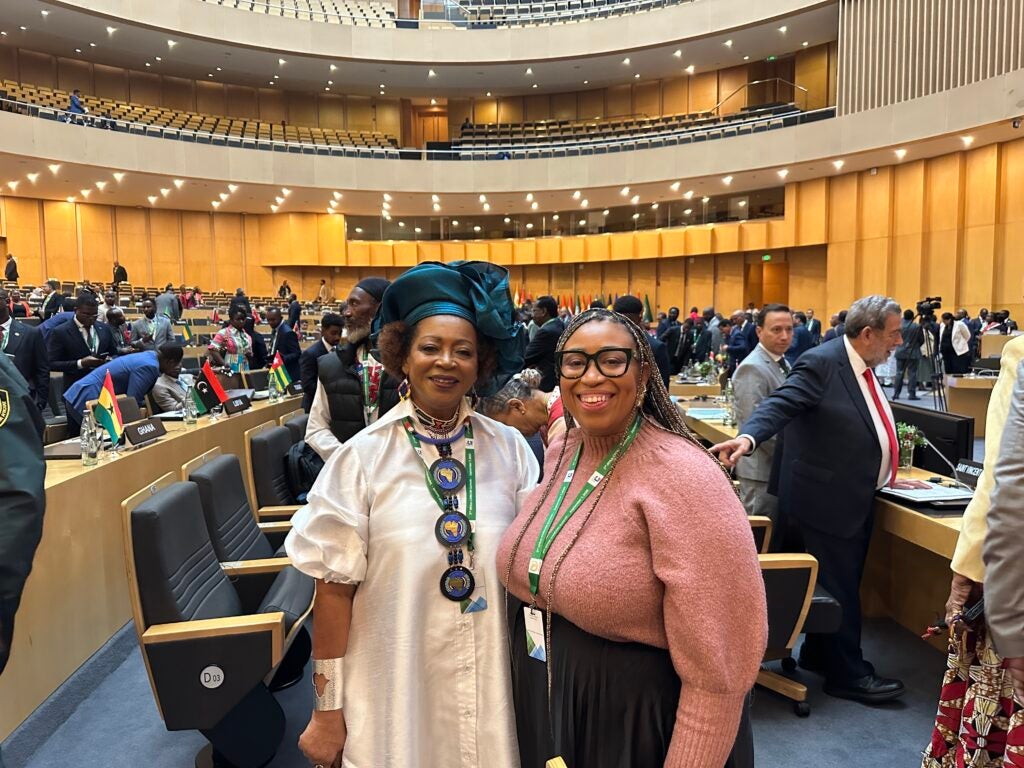
The Summit was well attended, with high-level representation including at least five CARICOM prime ministers and several African heads of state and government. As reported by The St. Vincent Times on September 7, 2025, the unanimously approved draft communiqué, offers as its final call to action:
“Heads of State and Government reiterated their unwavering call for reparatory justice for Africans and People of African Descent. They underscored that the enduring legacies of the transatlantic trade in enslaved Africans and chattel enslavement constitute grave crimes against humanity, which necessitate restitution, compensation and development. To this end, the Summit agreed to adopt “The Addis Ababa Declaration on Transcontinental Partnership in Pursuit of Reparatory Justice for Africans and People of African Descent Through Reparations.”
The meeting highlighted the importance of engaging with the African diaspora – particularly in countries with large populations of descendants of enslaved Africans, including the United States – though defining this relationship remains complex. Especially in the U.S. because descendants are a minority in a country reluctant to acknowledge enslavement’s enduring impact and one that has its own historical and contemporary involvement in neocolonialism, political interference, and resource extraction in these regions. Engagement with countries like Brazil currently seems more likely. Like our proposed efforts of reparations as public health intervention, health has been focal to the CARICOM ten-point plan. In this way we hope that transnational solidarity with reparatory justice coalitions globally could advance the ability to realize health equity across the African Diaspora.
For our full report, list of references and linked documents related to Reparatory Justice efforts undertaken by the African Union and CARICOM, please see here.
[The above represents solely the views of the authors and does not necessarily represent the views of the institution.]
Full report: Bridging The Atlantic: Legacy, Solidarity, and Reparations (link)
Reference list
- Caribbean Community (CARICOM) Reparations Commission (link)
- United Nations World Conference against Racism, Durban 2001 (link)
- Durban Declaration and Programme of Action (link)
- UN Working Group of Experts on People of African Descent (link)
- International Decade for People of African Descent 2015-2024 (link)
- Second Decade for People of African Descent (2024) (link)
- The Abuja Proclamation, April 27-29, 1993 (link)
- Global African Diaspora Summit Report (2012) (link)
- AU Decision Assembly/AU/Dec.847(XXXVI) on reparations mechanism (2021) (link)
- First AU-CARICOM Summit (Sept 7, 2021) (link)
- African Commission on Human and Peoples Rights resolution ACHPR/Res.543 (LXXIII) 2022 (link)
- Accra Proclamation on Reparations (2023) (link)
- Accra Summit I (2022) (link)
- Accra Summit II (2025) (link)
- Second AU-CARICOM Summit (Sept 7, 2025) (link)
- Draft communiqué of the 2nd Africa-CARICOM Summit (Sept 2025) (link)
- The St. Vincent Times report on the 2nd Africa-CARICOM Summit (Sept 7, 2025) (link)
- African Export-Import Bank (Afreximbank) (link)
- CARICOM-Afreximbank Partnership Agreement (2022) (link)
- Health Development Partnership for Africa and the Caribbean (HeDPAC) (link)
- Sustainable Development Goal 3 (SDG 3) (link)
- Agenda 2063: The Africa We Want (link)
- AU Theme of the Year 2025: Justice for Africans and People of African Descent Through Reparations (link)
- The collection of slavery compensation, 1835–43 (link)
- How Haiti paid for its freedom – twice over (link)
Other references
- Concept Note for the AU Theme of the Year 2025 (link)
- Resolution in Preparation for the AU Theme for 2025 (link)
- Building a United Front to Promote the Cause of Justice and Payment of Reparations to Africans (2024) (link)
- Durban Declaration and Programme of Action: 20th Anniversary of the Adoption (2021) (link)
- Intergovernmental Working Group on the Durban Declaration and Programme of Action (link)
- Reparations to Africa and the Group of Eminent Persons (2004) (link)